

Case Study: UCSF Finds Feature-Rich and Reliable Storage Platform to Grow at Scale for “World’s Largest” ZFS Instance
The Challenge
UCSF needed to consolidate ~50 petabytes of disparate research data across their organization into a single, shared, general-purpose research storage service. Their existing infrastructure was a mix of internally developed OpenZFS-based storage solutions which, while initially effective, lacked the high-availability, security and operational simplicity they needed for their rapidly growing capacity storage environment.
The Solution
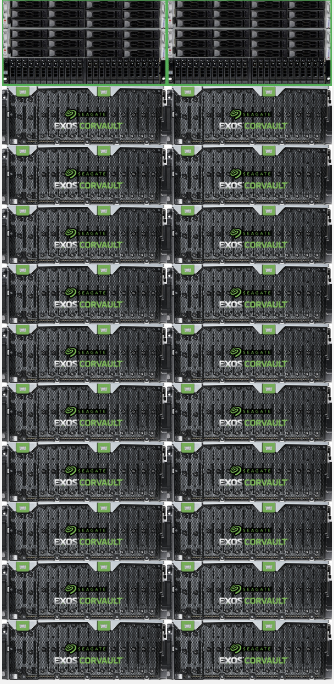
Working with their trusted HPC solution provider, Cambridge Computer, UCSF evaluated and selected the OSNexus QuantaStor storage platform that tightly integrates with the Seagate Exos EP auto-healing system hardware. QuantaStor stood out for its scalability, advanced security features, storage grid technology and its ease of automation via APIs, CLIs and other integration modules. The QuantaStor API enables UCSF to fully automate many storage provisioning workflows and streamlined the management of resources across their storage grid via QuantaStor’s global namespaces for NFS & SMB. OSNexus, Seagate, and Cambridge Computer crafted a solution for UCSF and coined it the “Tower of Power” for its scale (21PB) and durability, and it became known as the "world's largest" ZFS instance.
The storage cluster uniquely utilizes two layers of fault tolerance with software 8d+2p double-parity RAID layered over hardware 16+2 double-parity erasure coding within the Seagate Exos EP systems. This layering lends the solution extreme levels of durability such that the solution can sustain the loss of 4x devices per Exos EP (40x total) at the same time with zero downtime. In addition, with up to 40x devices offline another two complete Exos EPs can be powered off while still sustaining no downtime or loss of data. This level of durability is exactly what UCSF required to protect research data that needs fast access capabilities and long term durability.
“QuantaStor has given us the reliability, scalability, and automation capabilities we were missing with our previous systems. The platform is feature-rich, and the OSNexus, Seagate, and Cambridge teams have been outstanding — responsive, collaborative, and have enhanced the solution to meet our evolving needs and unique requirements.”
— Hunter M., Sr. Research DevOps Engineer, ARS – Facility for Advanced Computing at UCSF.
The Result
Leveraging the single integrated platform, UCSF has gained greater control over data sprawl across the campus, unifying previously fragmented storage environments into a centralized, easily managed system. The university has introduced an affordable chargeback model that empowers departments and researchers to efficiently store and access their data, while also providing an enhanced security layer to ensure compliance with sensitive data requirements. The unified platform now enables UCSF to maintain synchronized data copies across multiple sites—ensuring resilience, availability, and data protection—while providing a scalable, future-looking foundation that supports the university’s growing research and collaboration needs.